
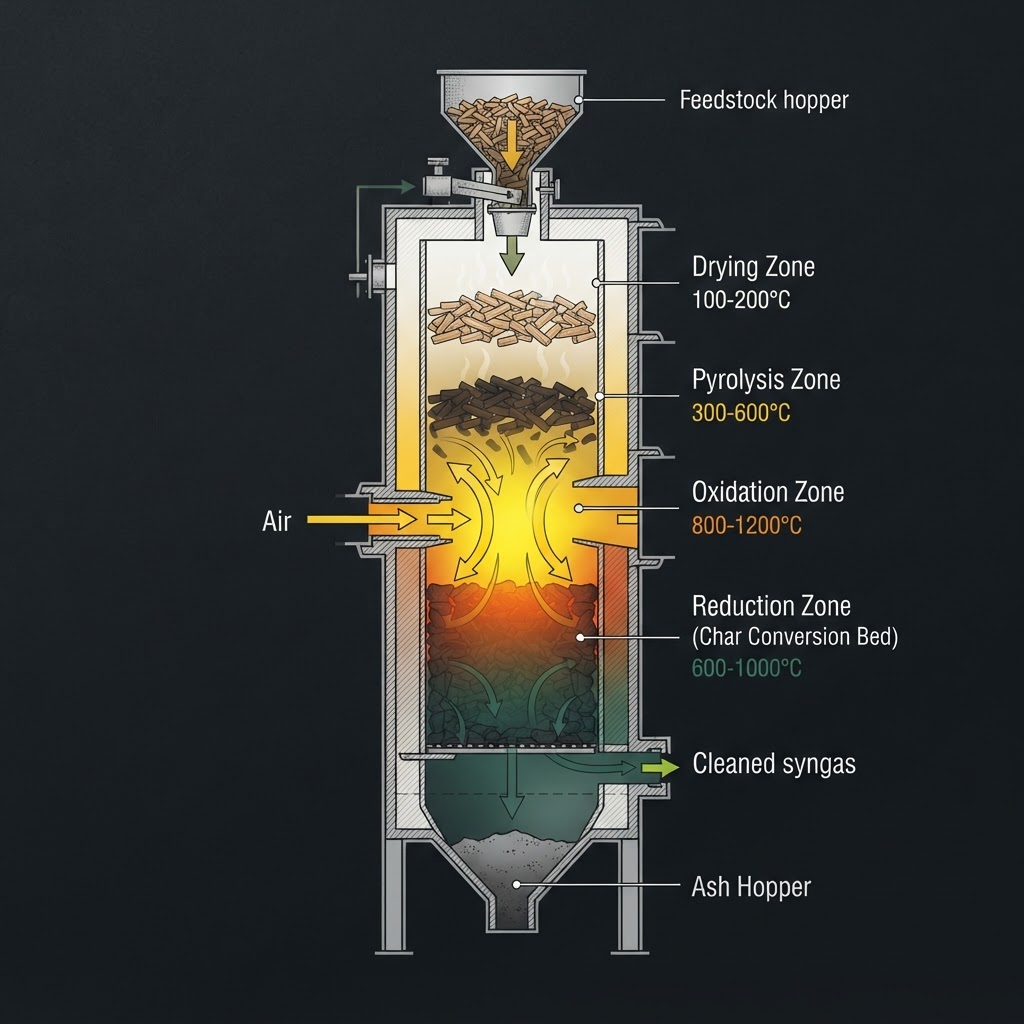
Ask for the biomass gasification temperature and most sources give you a single range: 800 to 1,100°C, with air, oxygen or steam as the gasifying agent (Sher et al.). That number is correct, but it hides the decision that matters. Inside one reactor the temperature spans more than a thousand degrees from top to bottom, and the operating point a plant can actually hold is boxed in from two sides. Run too cool and tar survives into the gas. Run too hot and the ash in the fuel starts to melt.
This guide gives the temperatures zone by zone and reactor by reactor, then explains how those two limits move with the feedstock. That is the part that decides whether a plant runs steadily or shuts down to chip clinker out of its bed.
The short answer: 800 to 900°C, inside a wider range
For most biomass plants the number to remember is 800 to 900°C. A 2023 review of bubbling fluidized beds found that most fluidized bed gasifiers fed with biomass operate in that window, and that pushing above 950°C adds little to gasification performance (Biointerface Research review).
The wider figures you will see quoted, from roughly 100°C up to 1,500°C, describe different things: the temperature of individual zones inside a fixed bed, or the far hotter regime of entrained flow reactors. Both are covered below.
Temperature by zone
In a fixed bed gasifier the fuel passes through four zones in sequence, each with its own temperature. If you want the chemistry of each step in more depth, start with how biomass gasification works; here the focus is the thermometer.
| Zone | Typical temperature | Heat balance |
|---|---|---|
| Drying | 100 to 150°C | Endothermic |
| Pyrolysis | 250 to 700°C | Endothermic |
| Oxidation | 800 to 1,200°C (up to 1,500°C at a downdraft throat) | Exothermic |
| Reduction | 650 to 900°C | Endothermic |
Drying
Moisture evaporates as the fuel warms. Drying is usually treated as complete once the biomass reaches about 120 to 150°C (Aston University review). The steam released here does not disappear: it can react further down the bed, and in non-steam gasifiers it is often the main source of hydrogen.
Pyrolysis
Above about 250°C the biomass starts to break down without oxygen. Cellulose, hemicellulose and lignin split into gases, condensable vapours and char (FAO). Primary pyrolysis runs to about 600°C and secondary pyrolysis continues above it (Sher et al.). This is where tar is born. If those vapours do not then pass through a zone that is hot enough for long enough, they leave the reactor and condense as tar and oil in cooler pipework.
Oxidation
Where air or oxygen enters, part of the fuel burns and supplies the heat for every other zone. Oxidation zone temperatures range from 800 to 1,300°C depending on gasifier and fuel (INFLIBNET course module). In a well designed downdraft throat they rise sharply to 1,200 to 1,500°C, which is what cracks most of the tar from the pyrolysis zone.
Reduction
Hot CO2 and steam react with glowing char to form CO and H2. These reactions absorb heat, so the gas cools as it passes through: from around 1,000°C leaving the oxidation zone to about 450°C at the end of the reduction zone, according to the same INFLIBNET module.
What measured zones look like
Textbook ranges are wide, so measured profiles help. A 2026 laboratory moving bed gasifier logged average zone temperatures at three setpoints (Saires et al., MDPI Energies):
| Setpoint | Drying | Pyrolysis | Oxidation | Reduction |
|---|---|---|---|---|
| 700°C | 320°C | 580°C | 700°C | 610°C |
| 800°C | 370°C | 660°C | 800°C | 710°C |
| 850°C | 390°C | 700°C | 850°C | 750°C |
At 800 to 850°C and an equivalence ratio of 0.2, that unit produced gas yields above 60 wt% and gasification efficiencies above 50%.
Temperature by reactor type
Reactor design changes the temperature profile more than anything else. A full comparison of designs is in our guide to types of biomass gasifiers; the temperatures are summarised here.
| Reactor | Operating temperature | Tar in raw gas | Ash leaves as |
|---|---|---|---|
| Updraft fixed bed | ~1,000°C at the grate, ~750°C after reduction | High, 10 to 20 wt% | Dry ash |
| Downdraft fixed bed | 1,200 to 1,400°C at the throat | Low | Dry ash |
| Fluidized bed | 800 to 1,000°C, evenly spread | Low to moderate | Dry ash and fly ash |
| Entrained flow | 1,200 to 1,500°C | Near zero | Molten slag |
Updraft
Air meets the char at the bottom first, burns it completely and lifts the temperature to about 1,000°C. The gases then cool to about 750°C as they rise through the bed, pyrolysing the incoming fuel on the way out. Because the pyrolysis vapours never pass through a hot zone, updraft units typically carry 10 to 20 wt% tar in the produced gas (Sikarwar et al., Energy and Environmental Science).
Downdraft
Fuel and gas travel together, so pyrolysis vapours are forced through the throat at 1,200 to 1,400°C and then over hot char. Both steps crack tar, so the gas leaves far cleaner than from an updraft unit.
Fluidized bed
Bubbling and circulating beds keep the temperature uniform at 800 to 1,000°C and are deliberately run below the ash softening point to avoid agglomeration (Kumar et al., Sustainable Energy and Fuels). They are the most widely deployed design among commercial biomass gasifiers, according to the same review.
Entrained flow
Finely ground fuel and oxygen react at 1,200 to 1,500°C with a residence time of seconds. The gas is close to tar free and the ash melts into slag. Slagging designs suit feedstock with more than 6% inorganic content, and the fine grinding they demand is one reason torrefied wood and biochar attract interest as entrained flow feeds (National Research Council Canada).
What temperature changes in the gas
Hydrogen, CO and methane
The main reduction reactions are reversible, so temperature shifts the equilibrium. Higher temperatures favour CO and H2 in the producer gas; lower temperatures leave more methane, as the INFLIBNET module notes. Pilot work with oxygen and steam in a fluidized bed found H2 content rising with gasification temperature and CO higher at 840°C (Wu et al.). For a fuller breakdown of the gas itself, see our upcoming guide to syngas composition.
Tar
Raising temperature usually lowers tar. In a steam and air bubbling bed run between 750 and 850°C, higher temperature improved the char gasification rate and reduced tar concentrations (Carpenter et al., AIChE Journal).
But not always. In air fluidized bed tests on palm empty fruit bunch, raising the temperature from 700 to 900°C increased gas yield, heating value and cold gas efficiency, and tar rose with them (Chemical Engineering Transactions). Temperature alone does not clean the gas. Residence time, oxygen supply and bed material decide how much of the tar actually cracks.
The target is set downstream. Allowable tar is around 0.05 g/Nm3 for gas engines, 0.005 g/Nm3 for gas turbines and 0.001 g/Nm3 for fuel cells, per the Sikarwar review. A plant feeding an engine can tolerate a cooler, cheaper gasifier with good cleaning. A plant feeding a fuel cell cannot.
Efficiency does not simply rise
Hotter is not automatically better. A process model of a multistage fluidized bed found that going from 800 to 1,000°C raised CO and H2 yields but lowered methane and cold gas efficiency. The best combination of efficiency and low tar came at 800°C, with cold gas efficiency reaching 69% (process model study, PMC). Every degree costs fuel, because the heat comes from burning part of the feedstock. Which efficiency figure to trust in a vendor quote is its own question, covered in this explainer on biomass gasification efficiency.
The ceiling: ash melting and bed agglomeration
The upper limit is the one vendor brochures rarely put in the headline. Biomass ash is rich in potassium and other alkali metals that form low melting compounds. At high temperature they soften, coat bed particles and fuse them together, and a fluidized bed can lose fluidization altogether. High temperature cuts tar, but it also sinters alkali ash, which is why the reduction zone temperature is a key design choice, as the Aston review puts it.
The threshold depends heavily on the fuel. From the Biointerface review and one pilot campaign:
- Grass pellets agglomerated above 800°C.
- Palm empty fruit bunch agglomerated at 1,050°C, so the plant was run at 770°C instead.
- Rice straw agglomerated at 850°C on an alumina silicate bed until magnesium oxide was added to raise the ash melting point.
- Poultry litter agglomerated at 750°C and forced an immediate shutdown. A 50/50 blend with beech wood ran at 750°C but agglomerated again at 800°C (Katsaros et al., Fuel).
Dropping to 600 to 650°C prevents sintering, but it also cuts energy performance. One workaround is to split the job. A two-stage design ran a fluidized bed at about 600°C, then cracked the tar over active carbon in a second reactor. It avoided agglomeration, produced gas comparable to operation at about 800°C, held 15 vol% H2 and left only 8 mg/Nm3 of toluene (Kim et al., Energy).
For the feedstocks that matter most in emerging markets (straw, husks, palm residues, manure), the ceiling is often lower than the textbook 900°C.
How operators set and hold the temperature
A gasifier has no burner dial. Its temperature is set mainly by how much oxidant goes in. Air gasifiers typically receive 30 to 40% of the air needed for complete combustion, per the INFLIBNET module. More air burns more fuel and raises the temperature, but it also leaves more CO2 and, with air, more nitrogen in the gas. Steam and the wider choice of gasifying agent shift the balance too.
Fuel moisture is the other lever. Gasification works best below 35% moisture, and wetter feedstock should be pre-dried to 10 to 20% to avoid losing energy inside the reactor (Sher et al.). Every kilogram of water the gasifier has to evaporate is heat that does not go into the reduction reactions. That is why we treat thermal pre-treatment as non-negotiable: it lowers moisture, raises energy density and evens out a variable feedstock before it reaches the reactor (Energaia on LinkedIn).
How Energaia picks the window for a project
Our process starts with local biomass or sludge and gasifies it at high temperature into clean syngas, which is then turned into dispatchable power and heat, with biochar and verified CO2 offsets as co-products (Energaia on LinkedIn). The temperature is chosen in a fixed order:
- Feedstock first. Ash content and alkali chemistry set the ceiling. A wood chip project and a rice straw project should not share an operating point.
- End use second. An engine, a turbine and a fuel cell each set a different tar limit, and that sets the floor.
- Reactor third. Only once the window is known does it make sense to choose updraft, downdraft, fluidized bed or a two-stage design that fits inside it.
- Simulate before steel. We model thermal behaviour and emissions digitally, including with our MATLAB-based VOC simulation suite, before equipment is ordered (Energaia).
If a vendor quotes a single temperature without asking what your fuel's ash looks like, ask them what happens at the top of their range on your feedstock.
FAQ
What is the minimum temperature for biomass gasification? Oxidation reactions need roughly 700°C or more to turn pyrolysis products into CO, CO2 and water, so most single-stage gasifiers run their hot zone above that. Two-stage designs can run the first reactor near 600°C and rely on a separate tar cracking step to reach usable gas quality.
Is gasification hotter than pyrolysis? Yes. Standalone pyrolysis runs at about 400 to 600°C with no oxidant, while gasification runs at 800 to 1,100°C with air, oxygen or steam. Pyrolysis aims to keep char and oil; gasification aims to convert as much carbon as possible into gas. Our pyrolysis vs gasification guide compares the two.
Does a higher gasification temperature always produce more hydrogen? It usually raises H2 and CO and lowers methane, but it does not always raise efficiency. Extra heat comes from burning more fuel, and in fluidized beds the gain above about 950°C is small while the agglomeration risk keeps growing.
How is the temperature inside a gasifier controlled? Mainly through the equivalence ratio, the share of air or oxygen supplied relative to full combustion. Adding steam, changing fuel moisture and adjusting feed rate also shift it. Thermocouples along the reactor show where each zone sits.